Religious Education
Vision
‘Religious Education contributes dynamically to a child’s education by provoking challenging questions about meaning and purpose in life, beliefs about God, ultimate reality, issues of right and wrong and what it means to be human.’
(NATRE – National Association of Teachers of Religious Education)
As a Church of England school within the Diocese of Norwich Education and Academies Trust (DNEAT), the broad aims of Religious Education (RE) teaching at Moorlands are laid out within the locally agreed syllabus (Norfolk 2019) and the Church of England Education Office Statement of Entitlement (2019). The syllabus enables our pupils to develop ‘religious literacy’. Being religiously literate means that they will have the ability to hold balanced and well-informed conversations about religion and worldviews. They learn to articulate their personal beliefs, ideas and values, whilst listening, reflecting and respecting the views of others. The children learn to make sense of religion and worldviews around them and begin to understand the complex world in which they live; helping them to flourish in an ever changing world.
Aims
The aims of Religious Education teaching at Moorlands are to enable each child to:
- Know about and understand Christianity as a living faith that influences the lives of people worldwide and as the religion that has most shaped British Culture and heritage.
- Give a theologically informed and thoughtful account of Christianity as a living and diverse faith.
- Know about and understand other major world religions and world views, their impact on society, culture and the wider world, enabling pupils to express ideas and insights.
- Show a well-informed, balanced and respectful attitude to religions and world views.
- Engage in meaningful and well-informed dialogue with those of other faiths and none.
- Reflect critically and responsibly on their own spiritual, philosophical and ethical convictions, exploring and enriching their own beliefs and values.
Delivery
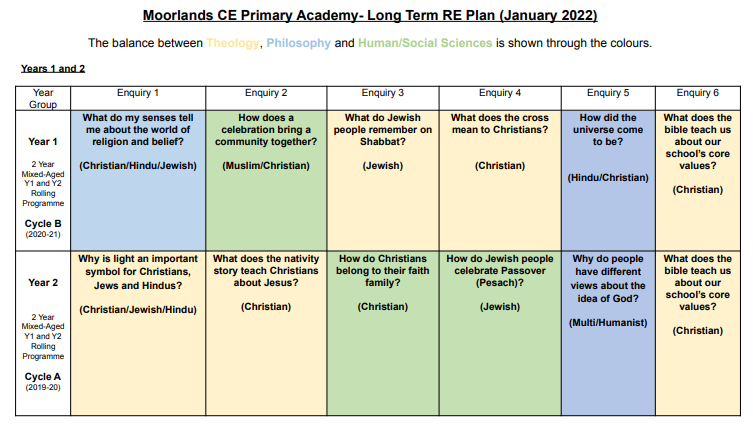
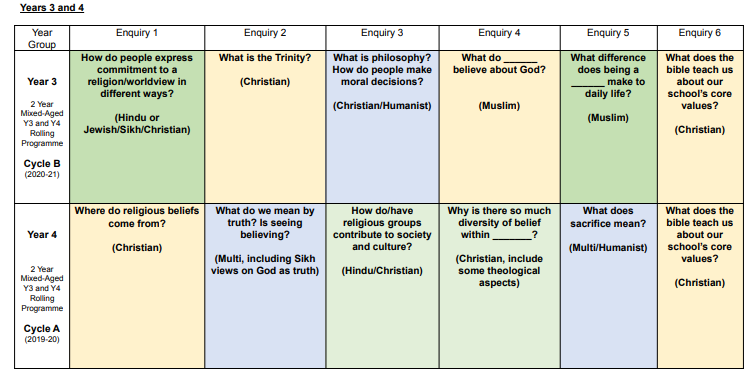
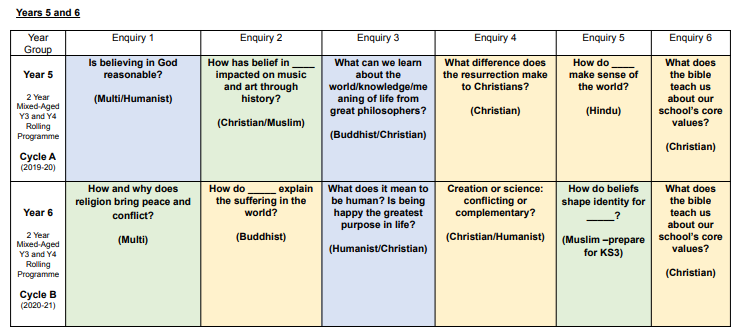
Our curriculum for RE is designed with ‘religious literacy’ at its heart. The multi-disciplinary approach to the design of our curriculum, provides a balance between theology, philosophy and the human/social sciences.
- Theology: This examines where beliefs come from, how they have changed over time, how they are applied differently in different contexts and how they relate to each other.
- Philosophy: This is about finding out how and whether things make sense. It deals with questions of morality and ethics. It takes seriously, questions about reality, knowledge and existence.
- Human/Social sciences: This explores the diverse ways in which people practice their beliefs, both now and in the past. It engages with the impact of beliefs on individuals, communities and societies.
At Moorlands, we use an enquiry-based approach to learning. This is based on the best practice framework in the Norfolk agreed syllabus. This approach enables pupils to focus on an enquiry or ‘big question’ which explores aspects of the theological, philosophical and human/social sciences. A range of teaching strategies are used to ensure learning is challenging and relevant including the use of art, music, thinking skills, artefacts and stories. Where possible we want our pupils to have opportunities to encounter local faith communities through visits to local places of worship or visit from members of local faith communities.
Coverage
Religious Education at Moorlands is delivered by class teachers and higher level teaching assistants (HLTAs) in accordance with the structure of the locally agreed syllabus for Norfolk (2019).
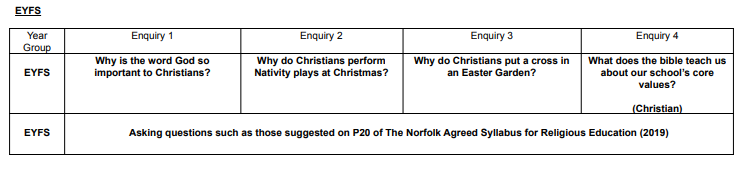
Pupils at Key Stage1 (Years 1 and 2) study primarily Christianity and Judaism, with reference made to other principal religions, beliefs and worldviews.
Pulis at Key Stage 2 (Years 3-6) study primarily Christianity, Islam and Hinduism, with reference made to other principal religions, beliefs and worldview.
In accordance with the Statement of Entitlement (2026), at least 50% of curriculum time is allocated to the teaching of Christianity. This entitlement is met through a weekly lesson of RE.
The areas of study are organised on a two-year rolling programme to reflect the mixed-aged class structure of our school.
Assessment
Pupils are assessed in terms of how they are making progress in relation to the theological, philosophical and human/social sciences disciplines within RE.
Pupils are assessed using age-related expectations which are common across all schools in DNEAT. Assessments are made in a variety of ways e.g. through written activities, role play, art work and discussion.
In broad terms the following principles have been applied to each aspect in terms of what it means to become more religiously literate:
- Extending knowledge and understanding from the concrete and familiar to the abstract and complex
- Moving from simple ideas and beliefs/concepts to making connections between them and placing these within a bigger picture or meta-narrative
- Demonstrating increasing layers of interpretation of religion, religions, beliefs and worldviews through engagement with a broadening and increasingly complex range of information
- Showing an increasing ability to critically question and form coherent, logical arguments, including increasing recognition of divergences of opinion about and the controversial nature of religion and belief
- Expressing a broadening understanding of diversity in terms of the nature of religion, religions and worldviews. Assessment is regarded as an integral part of teaching and learning and is a continuous process. It is the responsibility of the class teacher to assess all pupils in their class. We assess the children in order to ensure that they make good progress in this subject and to plan future work. In addition, pupils are encouraged to use self-assessment to evaluate their own knowledge and understanding. A comment about their progress is made in the annual report to parents.